
Dancing the Cocoa: From Cocoa Landscapes to Living Heritage
Part 2
By Anthea Grant
The History and Evolution of Dancing the Cocoa
The precise origins of Dancing the Cocoa are difficult to establish from the surviving historical record. Rather than attributing its beginnings to a single community or a single date, it is more useful to understand the practice within the plantation and cocoa-growing societies that developed in Trinidad and Tobago.
These communities brought together African-descended traditions, European colonial practices, Venezuelan agricultural knowledge, and, later, Indian labour and cultural influences. The dance therefore reflects a longer history of adaptation and cultural exchange. By the nineteenth and early twentieth centuries, workers were using rhythmic movement to turn and polish cocoa beans as part of the drying process, and the task could become a communal performance accompanied by music and song (NALIS; Newsday).
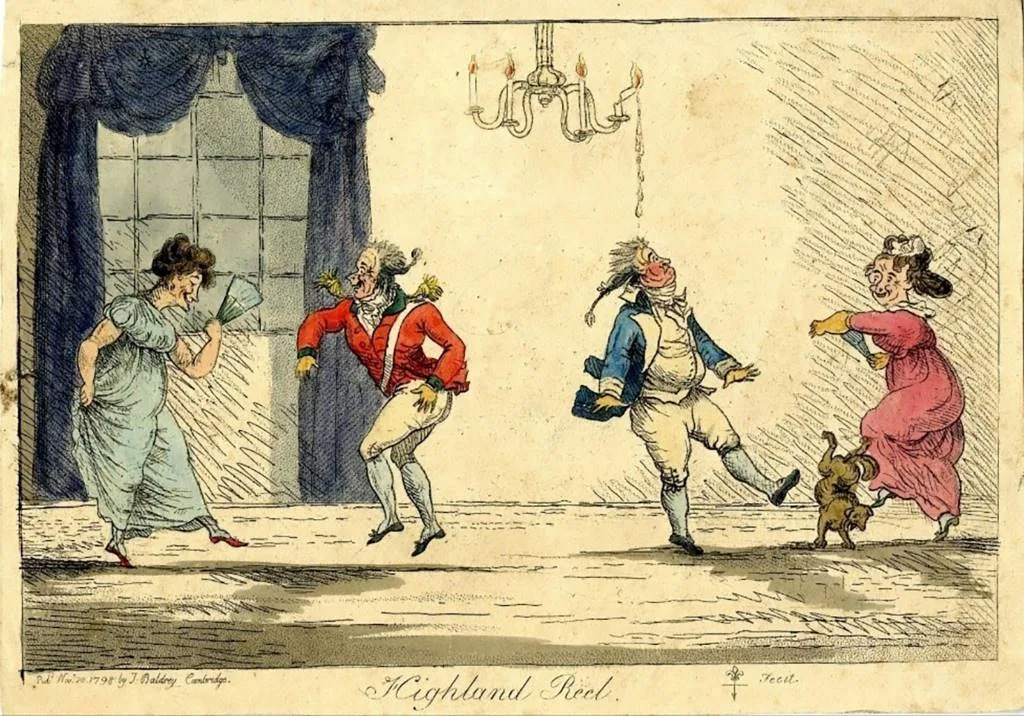
Comparisons with other African-derived and European-influenced movement traditions can help illuminate the broader cultural environment in which cocoa dancing developed. Richard Bridgens’s nineteenth-century images, for example, document dance among African-descended communities in Trinidad, while the Highland Reel and other European forms illustrate the wider repertoire of movement circulating in the colonial Caribbean. The Juba tradition of the United States also offers an interesting point of comparison because of its use of rhythmic footwork and percussive movement. These parallels, however, should be understood as comparisons rather than proof of a direct line of influence on Dancing the Cocoa.
|
|
|
|
Highland Reel, 1798, hand-colored etching, British Museum, London – Joshua Kirby Baldrey |
A group gathers as dancers perform the percussive Juba dance in a tavern setting, in an 1895 engraving by H. Helmlick originally published in The Century Magazine. |

Traditions and Technology
The transition from dancing the cocoa to mechanized drying systems reflects the broader evolution of the cocoa industry. Where workers once moved rhythmically across drying floors, carefully turning beans beneath the sun with practiced steps, modern machinery can now perform the task with greater speed and precision.
These innovations have improved efficiency and productivity, but they can also contribute to the gradual disappearance of traditional knowledge and cultural practices. The challenge for heritage preservation is therefore not to reject technology, but to ensure that technological change does not erase the knowledge and meanings attached to earlier ways of working.
Footsteps on the Drying Floor: Gender and Community in the Cocoa Drying House
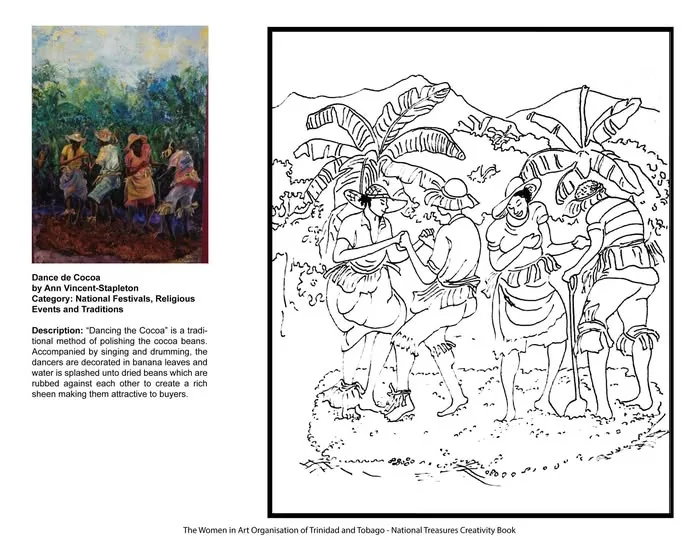
“Dance the Cocoa” © Ann Vincent-Stapleton. All rights reserved.
Dancing the cocoa reflected the social dynamics of life on Trinidad and Tobago’s cocoa estates. Historical accounts and photographs suggest that both men and women contributed to cocoa drying, although the practice of dancing itself appears to have varied between estates, with some accounts associating the dancing primarily with men. Within the cocoa drying house, turning and drying the beans brought workers together in a communal setting where labour, cooperation, and social interaction became intertwined.
Dancing the cocoa therefore provides a valuable lens through which to explore gender roles within rural cocoa-growing communities, revealing how different forms of labour contributed to the production process and to the cultural life of the estate. Recognizing the contributions of both women and men allows for a more nuanced and inclusive understanding of Trinidad and Tobago’s cocoa heritage—one that acknowledges not only the work involved in producing cocoa, but also the relationships, traditions, and cultural expressions that developed around it.
Courtship, Costume, and Communication: The Language of Dress in Cocoa Dancing
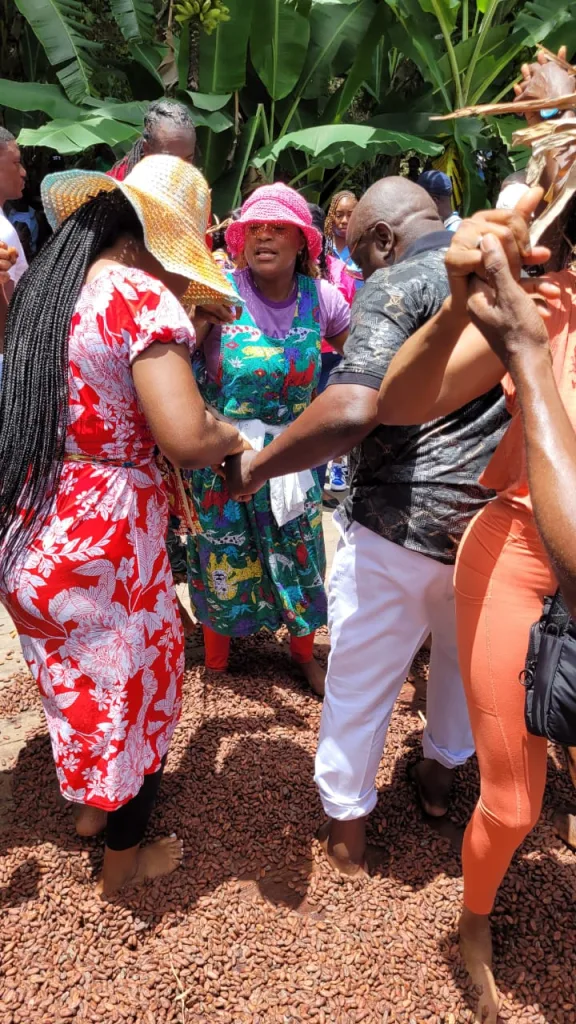
Dancing the Cocoa at Charlotteville, Tobago for the Natural Treasures Day, 2025. Photo by Wayne Benjamin
In cocoa-dancing traditions, clothing could carry both practical and visual meanings. Female dancers often used the movement of their skirts to create dynamic patterns that complemented the rhythm of the dance, sometimes used to attract male suitors. In performance, dress became part of the visual language of the tradition, helping to communicate energy, confidence, and social presence. Rather than treating costume as decoration alone, it can be understood as part of the embodied heritage of cocoa dancing.

Reenacting the Ritual of Dancing the Cocoa. Villagers clad in traditional banana-leaf attire perform the ancestral dance to polish and dry cocoa beans during the Tobago Heritage Festival. Photo by Visual Styles/Newsday
The clothing worn to dance the cocoa is not always pretty or practical; it can also be old and torn and complemented by dry leaves as seen in the image above. The performers wear traditional dried banana leaf headpieces and clothing embellishments while demonstrating the historical method of polishing cured cocoa beans using rhythmic, shuffling footsteps on a large wooden platform. Their attire—carefully fashioned from dried leaves and deliberately tattered garments—serves as a symbolic bridge to earlier eras. These costumes reflect the arduous nature of cocoa cultivation, the resourcefulness of estate workers, and the intimate relationship they maintained with the surrounding environment.
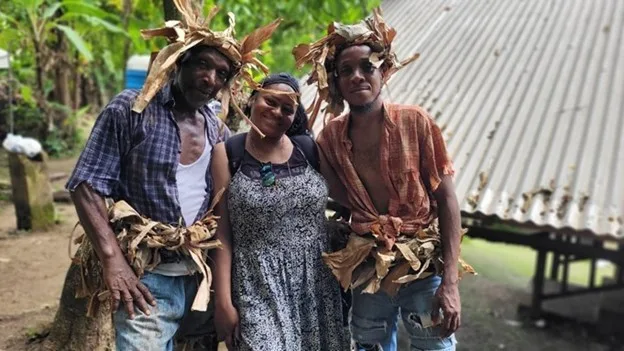
Anthea Grant (author) pictured between two cocoa dancers in Charlotteville, July 2025. Photo by: Wayne Benjamin
The Significance of Cocoa Drying Houses and Sense of Place
Cocoa drying houses became an important part of Trinidad and Tobago’s cocoa landscape. Their design varied according to estate, location, and period, but many incorporated raised or open drying floors and mechanisms that allowed workers to protect the beans from rain while permitting exposure to sunlight. The beans were spread across the drying floor and turned regularly to encourage even drying. Beyond their practical function, these spaces also served as places where work, social interaction, storytelling, music, and community life converged.
The drying process required repeated attention: workers spread the beans, turned them, and protected them from changing weather conditions. This repetitive labour created a physical setting in which rhythmic movement could become part of the work itself. The drying house therefore connected agricultural technology with human knowledge, memory, and performance.
The cocoa drying house was not merely a place where cocoa was processed; it was a place where culture was produced.
Music Genres of Dancing the Cocoa
Although Dancing the Cocoa is often remembered for its rhythmic movements, historical records provide limited evidence of a single musical tradition that accompanied the practice everywhere. The cocoa estates of Trinidad existed within a rich cultural landscape shaped by African, European, Venezuelan, and Indian influences. Rhythmic footwork, work songs, conversation, and communal interaction could provide the cadence of labour. Equally significant is the close historical relationship between the cocoa industry and parang.
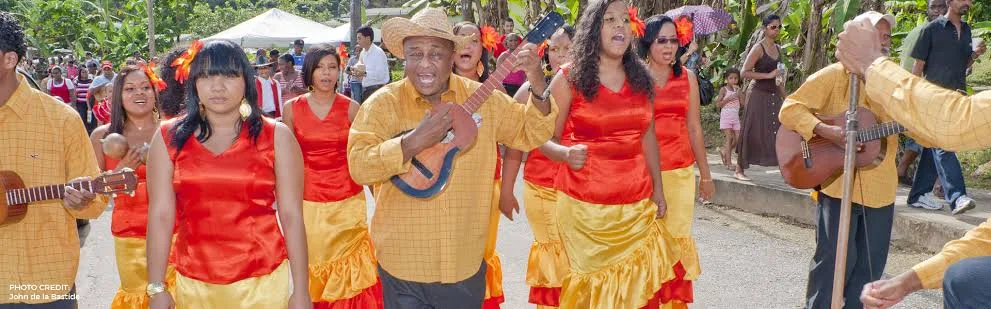
A group of parang singers, some of whom are considered to be descendants of Cocoa Panyols. John de la Bastide
Parang is a Trinidad and Tobago folk tradition strongly associated with Spanish-speaking communities and the cocoa-growing regions in which many Cocoa Panyols settled. Venezuelan migrants brought musical practices and instruments such as the cuatro and maracas, while the tradition developed within Trinidad’s own multicultural environment (Rouphail; National Trust). Its association with Christmas became particularly strong, but parang’s relationship with cocoa communities extends beyond the festive season.
Parang therefore became deeply associated with cocoa-growing valleys such as Lopinot, where Cocoa Panyol communities maintained Spanish-language traditions and musical practices. Rather than claiming that parang developed solely because of cocoa production, it is more accurate to say that the cocoa economy provided an important social and geographic setting in which the tradition took root and flourished. The music, agricultural landscape, seasonal rhythms, and community life became closely intertwined (Rouphail; National Trust).
Together with African-derived rhythms in Tobago and elsewhere, parang and the multicultural influences that characterized estate life contributed to a vibrant cultural environment in which cocoa dancing could be practiced, remembered, and reinterpreted. Understanding this diversity reminds us that cocoa heritage is not only a story of agriculture, but also one of music, movement, memory, and cultural exchange.
In Tobago, the rhythms associated with Dancing the Cocoa can be understood within the island’s rich tradition of African-derived music and drumming. Drumming became an important form of cultural expression among African-descended communities and developed into distinctive Tobagonian traditions such as tambrin. The tambrin ensemble traditionally features three differently pitched drums—the bass or boom, fuller or roller, and cutter—often accompanied by fiddle and iron or triangle. These instruments became central to Tobago’s musical, social, ceremonial, and dance traditions (Meyer; University of Trinidad and Tobago). In Charlotteville, this musical heritage became closely intertwined with cocoa culture: NALIS records that male cocoa dancers were instrumental in teaching new songs for dancing the cocoa, making music an important part of the performance tradition (NALIS).
Today, the tradition stands as a powerful reminder that cocoa production in Trinidad and Tobago was not merely an economic enterprise, but also a living cultural experience shaped by the many peoples who contributed to the nation’s history. Its survival in heritage festivals and cultural demonstrations demonstrates how an agricultural practice can move from everyday labour into the realm of intangible heritage.
Dancing the Cocoa invites us to look beyond the cocoa bean and into the human world that produced it. The drying house was a workplace, but it was also a social and cultural space where labour became movement, movement became rhythm, and rhythm became memory. Preserving cocoa heritage therefore means safeguarding more than historic buildings, landscapes, or agricultural techniques. It means recognizing the stories, skills, sounds, relationships, and embodied knowledge that gave those places meaning. As Trinidad and Tobago continues to rediscover and celebrate its cocoa legacy, Dancing the Cocoa offers a powerful example of living heritage: a tradition rooted in the past, performed in the present, and capable of carrying memory into the future.
References
- African Drumming at the Natural Day of Treasures, Charlotteville, Tobago. Tobago Festivals Commission Limited; Division of Tourism, Antiquities and Creative Industries
- Baldrey, Joshua Kirby. Highland Reel. 1798. Hand-colored etching. British Museum, London,
https://www.britishmuseum.org/collection/object/P_1948-0214-411.
- Benjamin, Wayne. Photo of Anthea Grant pictured with two cocoa dancers at the Charlotteville Natural Day of Treasures, 2025.
- Benjamin, Wayne. Photograph. A group of participants Dancing the cocoa at the Charlotteville Natural Day of Treasures, 2025.
- Biroo, Omatie Asha. Lopinot House. The National Trust of Trinidad and Tobago, nationaltrust.tt/location/lopinot-house/.
- Bridgens, Richard. Negro Dance. 1836. West India Scenery: With Illustrations of Negro Character, plate 6. Rare Books and Maps Collection, West Indiana and Special Collections, Alma Jordan Library, University of the West Indies, St. Augustine.
- De la Bastide, John. Lopinot Parang Festival, Trinidad. Angelo Bissessarsingh’s Virtual Museum
of Trinidad and Tobago, facebook.com.
- Helmlick, H. The Juba Dance. 1895. Wikimedia Commons, commons.wikimedia.org/wiki/File:The_Juba_Dance.jpg.
- Meyer, Andreas. “Moving Across a Stylistic Continuum: Tambrin Music in Tobago.” STM–SJM, vol. 14, 2011. https://doi.org/10.58698/stm-sjm.v14.55953.
- National Library and Information System Authority (NALIS). “The Cocoa Industry – Trinidad and Tobago Cocoa (Cacao).” NALIS, 2021, https://www.nalis.gov.tt/blog/the-cocoa-industry-trinidad-and-Tobago-cocoa-cacao/
- National Archives of Trinidad and Tobago. “Indian Arrival Day 2020: General Registers and Legacy of Indian Indentureship.” National Archives of Trinidad and Tobago, 2020, https://natt.gov.tt/node/257.
- National Archives of Trinidad and Tobago. “List of the Trinidad General Registers of Indian Indentureship 1845–1917.” National Archives of Trinidad and Tobago, https://www.natt.gov.tt/node/274.
- National Trust of Trinidad and Tobago. “Heritage of Cocoa in Trinidad and Tobago.” National Trust of Trinidad and Tobago, https://nationaltrust.tt/the-heritage-of-cocoa-in-trinidad-and-tobago/.
- National Trust of Trinidad and Tobago. “Parang Heritage Connection.” National Trust of Trinidad and Tobago, https://nationaltrust.tt/parang-heritage-connection/.
- Rouphail, Morgan. “The Surprising Origins of Parang, Trinidad and Tobago’s Christmas Folk Music.” Smithsonian Folklife Magazine, 19 Dec. 2018, https://folklife.si.edu/magazine/parang-trinidad-tobago-christmas-folk-music.
- Tobago Festivals’ Post on Dancing the Cocoa. Tobago Festivals Commission, 14 May 2020, facebook.com.
- University of Trinidad and Tobago, Academy for the Performing Arts. “UTT Faculty Members Learn Tobago Tambrin and Fiddle.” University of Trinidad and Tobago, 9 Feb. 2018, https://utt.edu.tt/apa/articles/6474
- Vincent-Stapleton, Ann. Dance de Cocoa. Illustration in The Women in Art Organisation of Trinidad and Tobago – National Treasures Creativity Book, Women in Art Organisation of Trinidad and Tobago, 2026.
- Visual Styles. Reenactment: “Dancing the Cocoa” at Charlotteville. Trinidad and Tobago Newsday, newsday.co.tt/2025/07/27/augustine-charlotteville-natural-treasures-day-more-than-a-festival/attachment/24279392/.