
Dancing the Cocoa: From Cocoa Landscapes to Living Heritage
Part 1
By Anthea Grant

Participants and cultural performers take part in the traditional “dancing the cocoa” ritual during Charlotteville Natural Treasures Day at the Tobago Heritage Festival, July 22, 2024. Photo by Visual Styles/Trinidad and Tobago Newsday
Trinidad and Tobago’s cocoa history is not only agricultural; it is also a story of culture, migration, resilience, rhythm, and identity. Cocoa has contributed to the socio-economic development of Trinidad and Tobago for over 200 years, and the history of the local cocoa industry has undoubtedly been illustrious. The Spaniards first planted the Criollo variety in Trinidad in 1525.
Trade in Trinitario cocoa, derived through hybridization between the original plantings and introduced Forastero cocoa, began in earnest in the 18th century when cocoa was traded at a very high price. By 1830, Trinidad and Tobago was the world’s third highest producer of cocoa, after Venezuela and Ecuador, producing 20% of the world’s cocoa (Bekele 4–12).
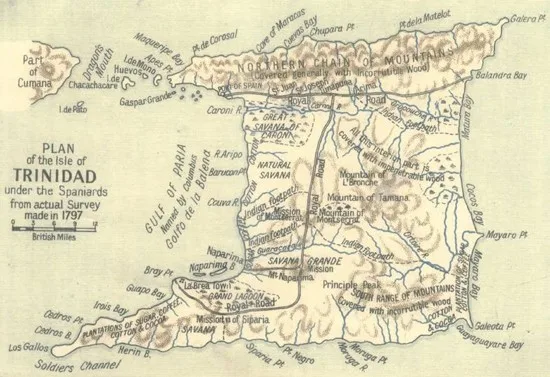
Plan of the Isle of Trinidad under the Spaniards from actual Survey made in 1797 – Mallet, Frederick. This map, by Capt. Frederick Mallet of the Royal Surveyors, details late-18th-century Indigenous footpaths, Spanish royal roads, and early agricultural settlements. Angelo Bissessarsingh, flickr.com
Cocoa cultivation in Trinidad was profoundly shaped by colonial expansion and the movement of diverse populations across the Caribbean and Northern South America. Under Spanish and later British colonial rule, the industry relied heavily on the forced labour of enslaved Africans. Venezuelan migrants subsequently became important to the development of the agricultural sector; nineteenth-century Spanish-speaking peons or conuqueros included people of Spanish, Amerindian, and African ancestry and brought knowledge of forest clearing and cocoa cultivation (Phillips Lewis).
French migration following the Cedula of Population of 1783 also accelerated the expansion of cocoa cultivation, bringing plantation knowledge, capital, and enslaved labour to the island (Bekele 4–12; National Archives of Trinidad and Tobago). Following the British capture of Trinidad in 1797, cocoa developed within a new colonial economic framework. The eventual abolition of slavery and the introduction of Indian indentureship brought additional communities into an already changing agricultural landscape (National Archives of Trinidad and Tobago).
Following the abolition of slavery, Indian indentured labourers began arriving in Trinidad in 1845, initially recruited to address labour shortages on the island’s plantations (Perry). Although most were employed in the sugar industry, Indian indentured workers were also assigned to cocoa and coconut estates, and some later became independent cocoa cultivators (Mahabir 16; National Archives of Trinidad and Tobago).
By the late nineteenth century, Indian labourers and their descendants had become part of the multicultural social and agricultural landscape surrounding Trinidad’s cocoa industry. Their presence contributed not only to estate labour and agricultural practices, but also to the cultural life of rural communities, through their food, religion, clothing, music, dance, and customs.
The cocoa economy continued to evolve through the influence of the “Cocoa Panyols”—Spanish-speaking communities descended largely from Venezuelan migrants who settled in Trinidad during the nineteenth and early twentieth centuries (Moodie-Kubalsingh). These communities preserved agricultural knowledge, language, foodways, music, and other traditions while becoming closely associated with cocoa cultivation. Their influence became especially prominent in communities throughout the Northern Range, including Lopinot, where cocoa production flourished and became central to village life (Moodie-Kubalsingh).
Over time, cocoa estates and villages became spaces where African, European, Venezuelan, and Indian influences intersected, creating a distinctly Trinidadian cultural landscape rooted in shared labour and adaptation. Within this dynamic environment emerged a number of traditional and intangible cultural practices, one of the most fascinating being the custom known as “Dancing the Cocoa.”
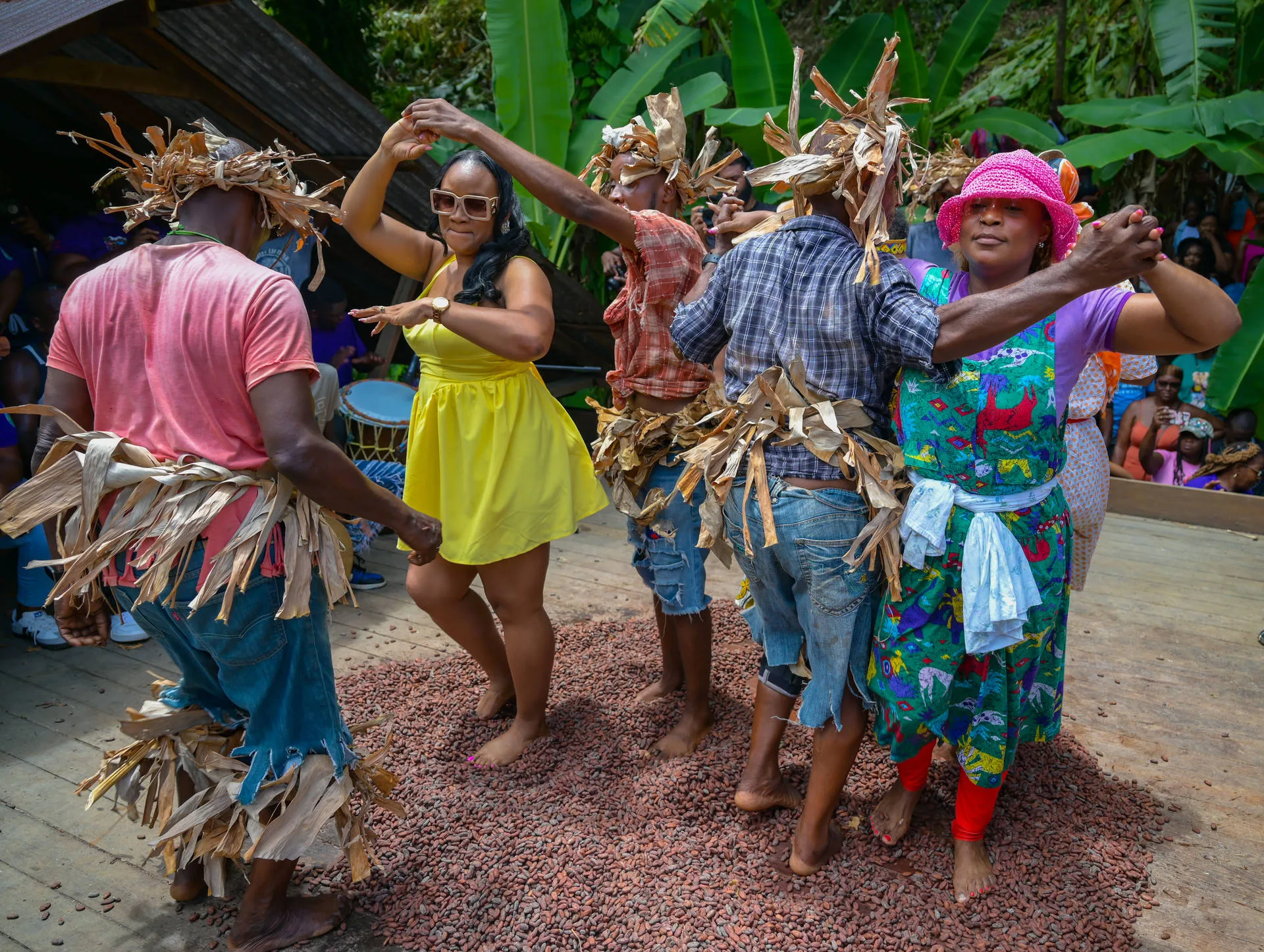
Costumed performers Dancing the Cocoa on the open tray of an old cocoa drying house at the Natural Day of Treasures, Charlotteville, Tobago[CA2.1][TG2.2][TG2.3], 2025. Tobago Festivals Commission Limited; Division of Tourism, Antiquities and Creative Industries.
The heritage of cocoa is not preserved solely in architecture and landscapes. It also survives in movement, music, dress, and the social relationships performed through traditions such as Dancing the Cocoa.
The ritual of “dancing the cocoa” was a critical economic strategy driven by market demands. Manual labourers shuffled over the fermenting beans inside open-air cocoa houses to keep the heavy layers turning, ensuring they dried completely and evenly under the tropical sun to prevent mold. More importantly, this grueling rhythmic process stripped away the remaining sticky pulp and polished the skin of each bean to a distinct, lustrous red finish. Because international merchants associated a clean, polished appearance with premium quality, this physical labor directly ensured that Trinidad and Tobago’s high-grade Trinitario crops could fetch the highest possible price on the competitive global market (Tobago Festivals; Dancing the Cocoa).

Cultural Fusion Dance inside a Trinidadian Cocoa House. Performers showcase a joint Indian Kathak and Venezuelan Spanish dance routine on a cocoa drying floor, celebrating the shared labour history of the estate workers. Trini Chocolate Blog.
About the author:
 Anthea Grant, Heritage Preservationist.
I use history, design, and storytelling to help people see the beauty in places, cultures, and ideas they might otherwise overlook.
I never imagined that heritage preservation would become my career, yet, like so many of my life experiences, I have come to believe that I was destined for this work. Discovering this niche and deeply rewarding field has been both exciting and transformational. For me, the opportunity to bring historic places, cultural traditions, and the stories of the people who shaped them to life is nothing short of fascinating.
As a museum professional and occasional artist, with a background in Mass Communication, I am drawn to the intersection of creativity, history, and storytelling. I believe that heritage is not simply about preserving the past; it is about finding meaningful and imaginative ways to help people connect with it in the present. Every place has a story, and every story offers an opportunity to discover something new.
Beyond my work in museums, the arts, and heritage, I enjoy travelling and exploring the great outdoors, while also cherishing moments of solitude that allow me to reflect and recharge in the midst of the hustle and bustle of life. I am a foodie and an enthusiastic sports fan, particularly when it comes to football and track and field—interests that provide a welcome balance to my professional life.
I consider myself a lifelong learner because we truly never stop learning. That is perhaps what I love most about heritage work: there is always another place to explore, another tradition to understand, another piece of history to uncover, and another story waiting to be told.
Read more on my research here: https://arcg.is/095Hzf1.
References
- Bekele, Frances L. “The History of Cocoa Production in Trinidad and Tobago.” Proceedings of the APASTT Seminar–Exhibition: Re-vitalisation of the Trinidad & Tobago Cocoa Industry, 20 Sept. 2003, St. Augustine, Trinidad, 2004, pp. 4–12. Cocoa Research Unit, The University of the West Indies, https://sta.uwi.edu/cru/sites/default/files/cru/HistoryCocoaProductionTT.pdf.
- Cultural Fusion Dance inside a Trinidadian Cocoa House. Trini Chocolate Blog, trinichocolateblog.com.
- Dancing the Cocoa during Natural Treasures Day, Charlotteville. Tobago Festivals Commission Limited; Division of Tourism, Antiquities and Creative Industries.
- Mahabir, Kumar. “Indian Indentured Labourers in Trinidad also Cultivated Cocoa.” Think India Journal, vol. 26, no. 1, 2023, p. 16.
- Mallet, Frederick. Plan of the Isle of Trinidad under the Spaniards from actual Survey made in 1797, Angelo Bissessarsingh, https://www.flickr.com/photos/39646565@N05/5270542187
- Moodie-Kubalsingh, Sylvia. The Cocoa Panyols of Trinidad: An Oral Record. British Academic Press, 1994.
- Perry, John Allen. A History of the East Indian Indentured Plantation Worker in Trinidad, 1845–1917. Louisiana State University and Agricultural and Mechanical College, 1969. PhD dissertation.
- Phillips Lewis, Kathleen E. British Imperial Policy and Colonial Economic Development: The Cocoa Industry in Trinidad, 1838–1939. University of Manitoba, 1994. PhD dissertation.
- Visual Styles. Dancing the cocoa. 22 July 2024. Trinidad and Tobago Newsday, co.tt/2024/07/22/charlotteville-alive-for-natural-treasures-day/attachment/23241742/