
In Small Island Developing States (SIDS) such as Trinidad and Tobago, heritage is more than the physical remnants of the past, and instead is a living expression of identity, memory, and national development. However, the increasing impacts of climate change, including coastal erosion, flooding, and sea level rise, pose significant and immediate risks to these irreplaceable assets.
Recognising this urgency, during my time at the National Trust of Trinidad and Tobago, I wrote and led the Resilient Heritage Trinidad and Tobago project, which is an initiative that represents a strategic shift in how heritage is documented, understood, and protected in a changing climate. I applied and was successful in getting the project funded by the prestigious U.S. Ambassador’s Fund for Cultural Preservation and was done in partnership with the University of Florida, Historic Preservation Department, and the Craig Group. This was the first project dealing with climate change and heritage in Trinidad and Tobago.
Read the final report of the project in the link here
Addressing Heritage Vulnerability
Heritage sites across Trinidad and Tobago are increasingly exposed to environmental pressures. From historic urban centres to coastal cultural landscapes, these spaces face compounding risks that threaten both their physical integrity and their cultural significance.
The project focused on two priority cultural landscapes: Nelson Island, and downtown Port of Spain sites; namely Fort San Andres, PTSC/Old Railway Station and St Vincent Jetty Lighthouse. Each site reflects critical aspects of the nation’s history, from colonial development to narratives of enslavement, migration, labour, and resistance. By concentrating efforts on these pilot sites, the project was able to develop targeted, evidence-based strategies that can be adapted and applied to other heritage locations nationwide.
Integrating Technology and Risk Assessment
A key strength of the project was its use of advanced digital documentation techniques, including terrestrial LiDAR scanning, drone surveys, and 3D photogrammetry. These tools enabled the creation of detailed digital records of heritage assets, ensuring their preservation in both physical and virtual forms. More importantly, these datasets informed climate risk modelling. By visualising potential impacts such as flooding and sea level rise, the project translated climate data into actionable insights. This approach supports more informed decision-making and strengthens the integration of heritage considerations into national climate adaptation planning.
Community-Centred Heritage Management
The Resilient Heritage project placed strong emphasis on public engagement. Through national surveys and stakeholder workshops, individuals and communities contributed to identifying the heritage assets they value most. This participatory approach reinforces the principle that heritage management must reflect the perspectives and priorities of the people it serves. It also strengthens the role of communities as active partners in safeguarding cultural resources.
Building Capacity for the Future
Beyond research, the project prioritised knowledge sharing and capacity building. Initiatives such as the “Keeping History Above Water” conference and targeted training sessions created opportunities for local professionals, students, and stakeholders to engage with emerging tools and methodologies in heritage resilience. This investment in capacity ensures that the work initiated by the project can continue to evolve, supporting long-term sustainability in heritage management across Trinidad and Tobago. The entire conference was recorded and is available on YouTube for viewing here
A Model for Small Island Developing States
The Resilient Heritage Trinidad and Tobago project demonstrates the value of integrating heritage conservation with climate resilience planning. Its methodologies provide a scalable framework for other SIDS facing similar environmental and resource challenges. By combining scientific data, technological innovation, and community engagement, the project establishes a holistic model for safeguarding heritage in vulnerable contexts.
Looking Ahead: A Call to Action
The future of heritage in Trinidad and Tobago, and across Small Island Developing States, depends on what we do next. There is an urgent need for policymakers to integrate heritage resilience into national climate strategies, for institutions to invest in digital documentation and risk assessment, and for practitioners to adopt interdisciplinary approaches that bridge conservation and climate science.
Equally, communities must continue to be empowered as stewards of their heritage, ensuring that preservation efforts reflect lived realities and shared values. The Resilient Heritage Trinidad and Tobago project has laid a strong foundation. The challenge now is to build on it.
Stakeholders across the public and private sectors, cultural institutions, and civil society are encouraged to engage with the project’s findings, adopt its methodologies, and champion the protection of heritage as a critical component of national resilience. Because in safeguarding heritage, we are not only preserving the past, we are strengthening our capacity to navigate an uncertain future.
Publication alert just in time for International Day for Monuments and Sites
The Routledge Handbook on Cultural Heritage and Climate Justice, edited By Mesut Dinler and William Megarry was recently published for 2026 and featured this project as Chapter 5 entitled Resilient Heritage Trinidad and Tobago: An Interdisciplinary Approach to Building Resilience and Adaptation, written by Kara Roopsingh, Cleary Larkin, Kimberly Rose.
This chapter examines how cultural heritage in Trinidad and Tobago is increasingly at risk due to climate change, and how SIDS must respond with urgency, innovation, and a strong commitment to equity. A central focus of this chapter is the Resilient Heritage project. At its core, this chapter situates cultural heritage within the broader context of climate injustice. Small island states like ours contribute the least to global emissions yet face some of the most severe consequences. In this context, the loss of heritage is not only physical but it is cultural, historical, and deeply human.
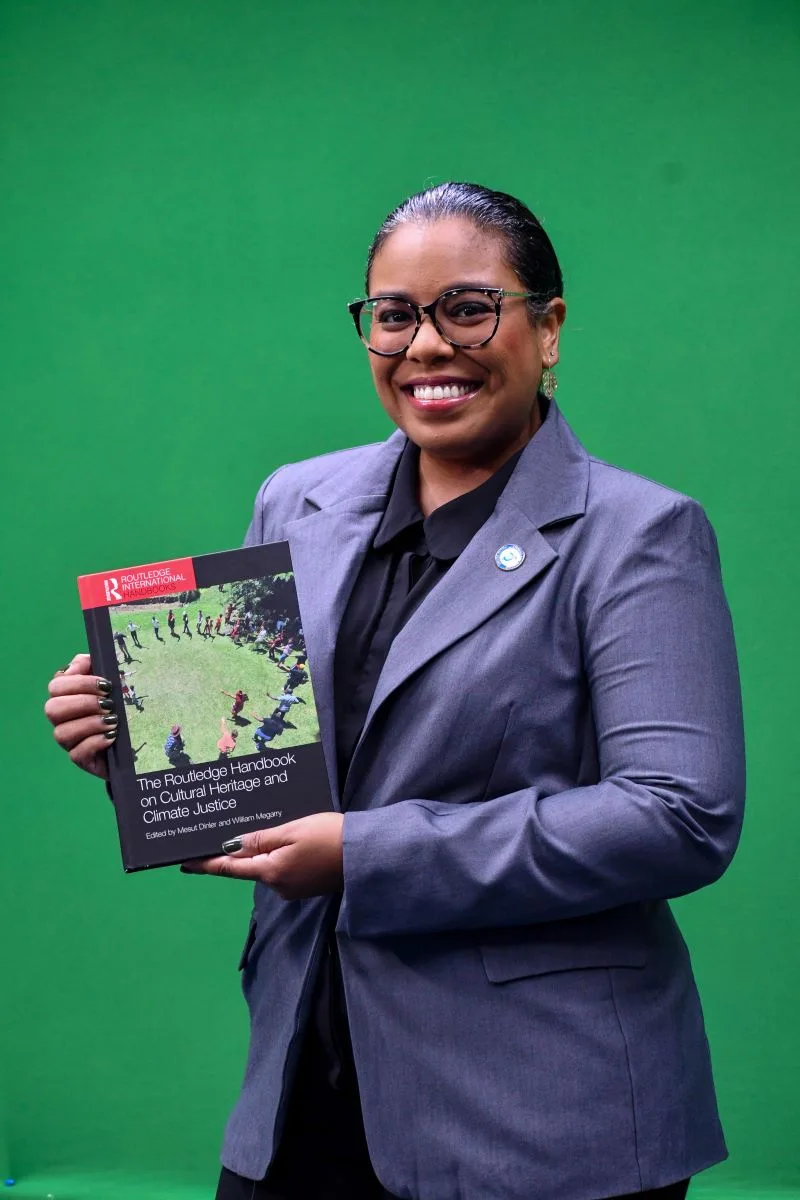
Photo of Kara Roopsingh, Resilient Heritage Project Lead and co-author of Resilient Heritage Trinidad and Tobago: An Interdisciplinary Approach to Building Resilience and Adaptation.
One key message from this work is that climate justice must include cultural heritage. Protecting heritage is not a luxury, it is an issue of equity. It is about whose histories are preserved, whose identities are protected, and whose voices are included in shaping the future. The Routledge Reader features voices and chapters from all over the world and Chapter 5 is the only one featuring Trinidad and Tobago.
I invite you to engage with this chapter as part of a wider call to recognise heritage as central to climate justice, and to support more inclusive, resilient approaches to safeguarding it. Safeguarding heritage is a shared responsibility. I believe through collective action, it is possible to ensure that Trinidad and Tobago’s cultural legacy is not only preserved but strengthened against the challenges of the future.
Want to purchase a copy of the book? Click here
 Loading...

 Reload document
  Open in new tab
 Author: Kara Roopsingh