
Karishma Nanhu, Heritage Preservation and Research Officer, National Trust of Trinidad and Tobago
For the first time in Trinidad and Tobago, digital technology has been used in heritage preservation to create an immersive experience with widespread public access. The National Trust of Trinidad and Tobago has partnered with CyArk to create a Tapestry of the Exchange Sewala. Through the Tapestry, the information and knowledge that was once confined to small groups, is now available to everyone via an interactive 3D experience.
CyArk is a globally recognised non-profit organisation specialising in the digital documentation of cultural heritage. This collaboration between the Trust and CyArk was made possible through the facilitation and support of the United States Embassy in Trinidad and Tobago, through funding from the US State Department. CyArk uses high-resolution 3D models to preserve important heritage sites. They promote awareness of the fragility of cultural heritage, and the importance of preservation. CyArk has documented over 200 heritage sites worldwide, including Machu Picchu and Angor Wat. The Exchange Sewala Tapestry is CyArk’s first project in the southern Caribbean. CyArk was established in 2003 with a mission to capture, archive and share the world’s cultural heritage to create a Cyber Ark. The Tapestry platform is an innovative web-based storytelling tool that integrates 3D images, oral histories, and interpretive narratives to create immersive, globally accessible experiences of culturally significant sites.
The historic Exchange Sewala was chosen as the project site because of its importance. When we think about the legacies of Indian indentureship in Trinidad, intangible cultural heritage immediately comes to mind. However, when it comes to built heritage, there are only a few examples of structures that were built by indentured Indians that are still standing, and which maintain their authenticity. Today, the Exchange Sewala is the only religious leepayed structure that was built by indentured Indians in the late 19th century, which still exists with much of its original design intact. It is one of a kind in Trinidad and Tobago. The Trust recognizes the national significance of the Sewala and in 2019 it became a listed property of interest, under the National Trust of Trinidad and Tobago Act of 1991, Chapter 40:53. This is also why the Trust has worked with its partners to digitally preserve the Sewala, to create a permanent record of not just the building, but also the traditions, rituals and community stories enmeshed with it.

The Exchange Sewala also known as The Mud Temple
The Trust has been working with the Exchange community to preserve the Sewala through monitoring, offering guidance and volunteering. The Sewala is a leepayed structure, which means it is made from a mixture of cow dung (gobar), sapaté mud and water, which is reapplied to the walls and floors every 2-3 months, by hand.

National Trust Volunteers and Staff leepaying the Exchange Sewala, February 2025
 |
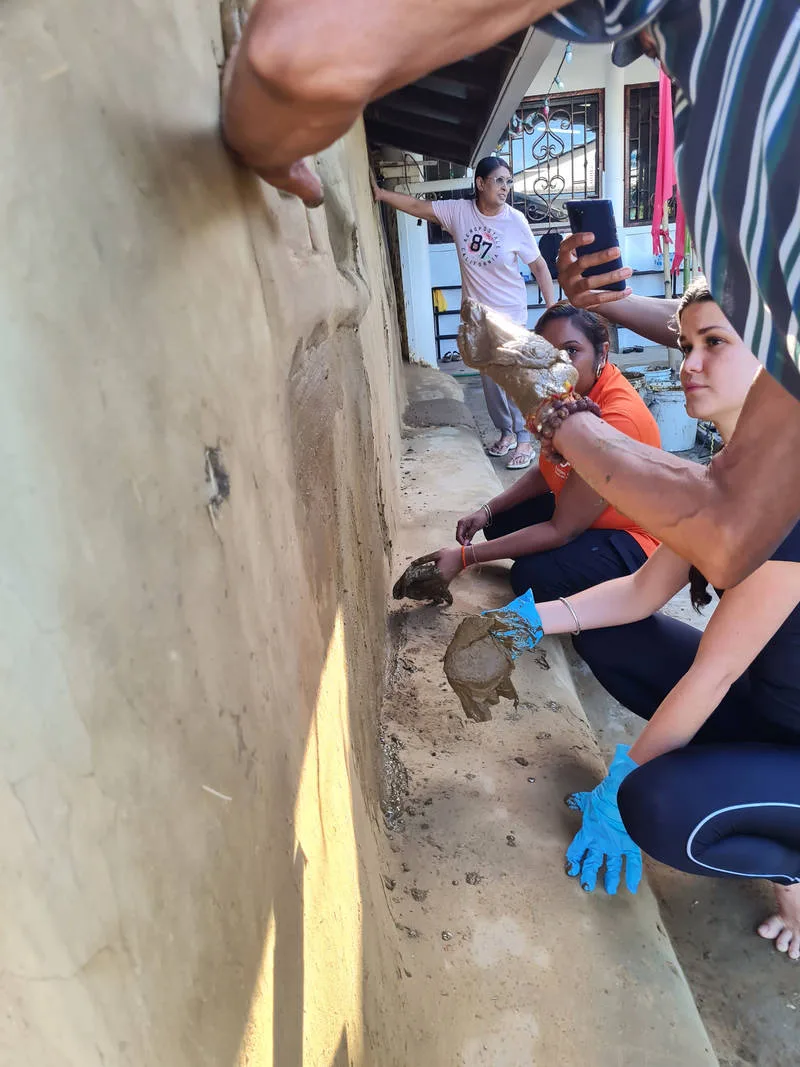 |
National Trust Volunteer, Ashley Adams, leepaying the Exchange Sewala, February 2025
There are numerous challenges to preserving a leepayed structure. After more than a century of leepaying, some of the details in the reliefs have become smooth. Additionally, in the 1980s the roof collapsed and two walls of the inner sanctum were destroyed. The reliefs on those walls were never documented and now they have been lost. Now the 3D model has captured the remaining reliefs with precise information, and this will be instrumental to the Trust in guiding restoration works.

A FARO Focus laser scanner being used for photogrammetry of the interior of the Exchange Sewala by the CyArk team
This project entails heritage preservation as well as public education, two things that the Trust is mandated to do under the National Trust Act. The Tapestry is essentially a virtual tour, which allows users to experience the Sewala through their own devices, allowing people the opportunity to access and interact with culture at their own pace.
Work on the project began in 2025, with a team of experts from CyArk visiting Trinidad at the end of July. Local participants, including students and community members, participated in workshops that took place from July 29th to August 1st, 2025. Twelve participants from a range of local institutions, including the University of the West Indies, were selected to participate in this intensive, hands-on training in cultural heritage documentation and digital storytelling. The workshop comprised two core modules, Storytelling where participants were introduced to place-based storytelling, community engagement, and conducting oral history interviews, and 3D Capture, where participants were introduced to photogrammetry and 3D capture techniques. During the workshop, the members of the Mandir also demonstrated how to leepay, and how to construct a mud wall, traditional building techniques which are slowly being lost.

Local participants learning about 3D digital capture from the CyArk team
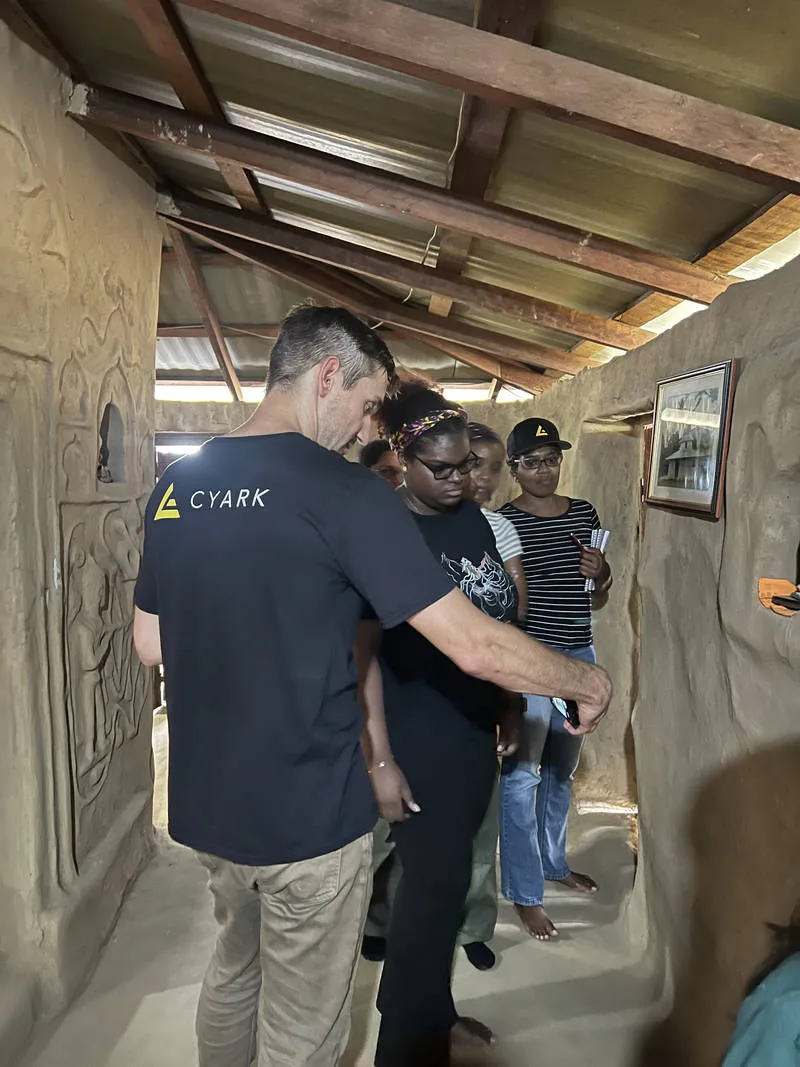
Local participants learning about 3D digital capture from the CyArk team
The irreplaceable Exchange Sewala has lasted for more than 100 years and now thanks to CyArk, it will exist forever virtually. Through this Tapestry, this historic Sewala is now showcased alongside other momentous heritage sites around the world. As the first southern Caribbean heritage site to be documented by CyArk, this is a considerable milestone in heritage preservation for the National Trust of Trinidad and Tobago. The Tapestry brings the Sewala to life, not just for the people within the community and the nation, but for the Indian Diaspora and the world. To view the Tapestry, visit the National Trust’s website at https://nationaltrust.tt/. To find out more about supporting the work of the Trust, please email us at info@nationaltrust.tt.

The participants in the workshop, National Trust staff, the CyArk team, and the Exchange Mandir community members
Sources
Google Arts & Culture. CyArk’s Journey to Preserve Our Shared Heritage. Words by John Ristevski. https://artsandculture.google.com/story/cyark-s-journey-to-preserve-our-shared-heritage/uAVxgukOpwsKJA?hl=en
Guinebretière, Nicolas. 2016. ‘Cultural Heritage Spotlight: CyArk, digitally archiving the world’s heritage’. Sketchfab Inc. https://sketchfab.com/blogs/community/museum-spotlight-cyark-digitally-archiving-worlds-heritage/#:~:text=CyArk%20is%20a%20nonprofit%20organization,eye%20towards%20their%20perpetual%20preservation.
National Trust of Trinidad And Tobago Act o 1991, Chapter 40:53, As Amended. [online] URL: https://nationaltrust.tt/national-trust-act/
Tapestry. 2026. https://tapestry.cyark.org/