
Written by: The Heritage Preservation and Research Department
09/04/26
Trinidad and Tobago has a rich heritage, this is seen through the numerous heritage assets around the country. These are buildings, monuments, objects, sites, places, areas and landscapes which are important historically, archaeologically, naturally, architecturally and more. In Trinidad and Tobago, our heritage assets are representative of our diverse peoples and our collective contributions to society. Our heritage is important not just within our communities but nationally. To date, the National Trust has over 400 assets on its Heritage Asset Inventory. The inventory is a record of the heritage assets across the Trinbagonian communities, and it is continuously growing.
Every heritage asset tells a story which makes up the fabric of our national story. The drinking fountain for people and drinking trough for animals in the Queen’s Park Savannah tell the story of the infrastructural development of our capital city, about supplying water. They were built in the 1850s, making them on average 176 years old. These are significant not just because of their age, or because they were gravity driven but also because they emphasize the communal value of the Savannah. They were built as part of the Lord Harris’ piped water distribution project from Maraval into Port of Spain. Like many buildings and monuments of that time, they were built using lime mortar, a local construction material. These historical remnants are evidence of the significance of the Queen’s Park Savannah to the citizens of Trinidad and Tobago. At a time when access to clean water was a challenge for the majority of the population, the trough and the fountain would have been a welcomed respite to travelers and their animals. Additionally, Indian immigrants from Boissiere village in Maraval, tenants of the Champs Elysees Estate, paid a dollar a month at the Town Hall, for their cattle to graze in the Savannah, which was partly used for pasture at the time.

Historical picture of cattle drinking water from a trough, Queens Park Savannah. Photo Credit, Geoffrey Maclean.
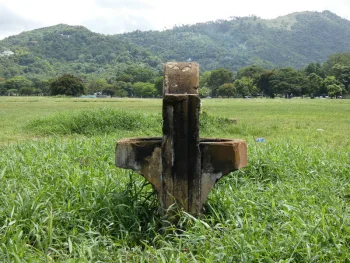
Unfortunately, the current state of the fountain and the trough are not ideal. The National Trust, however, cannot police every individual interaction with these and the numerous heritage assets across the nation.

The animal drinking trough in the Queen’s Park Savannah, 2025 Photo Credit: Karishma Nanhu
 |
 |
The drinking fountain in the Queen’s Park Savannah, 2025 Photo Credit: Zara Ali
Another important heritage asset is the Claxton Bay Maiden. Located on a hill overlooking the Sir Solomon Hochoy Highway, near Claxton Bay flyover, this statue is tied to a well-known lore in Trinidad which has been passed through word of mouth for decades. This piece of oral history begins with the forbidden love in the early 20th century between the daughter of the Forres Park Sugar Estate Overseer, Maria and an Indian indentured labourer. Upon finding the two lovers, the Overseer forbade his daughter from seeing the labourer but she did not comply. This resulted in the Overseer’s plan to kill the labourer however, Maria discovered this and tried to warn her lover. In her journey to warn him, she was bitten by a snake and fell from the hill near to the road.
The overseer, grief-stricken by the news of Maria’s death constructs a statue of the Virgin Mary on the estate’s tallest hill in an effort to seek forgiveness. Over the years this story has evolved to include a paranormal element with multiple accounts from persons claiming to have seen Maria’s ghost attempting to cross the highway. This area is known for its many fatal car crashes and has been dubbed the “most deadly strip of road in Trinidad” (Daily Express, May 24, 2009). Many believe this is the work of Maria’s ghost. The statue currently stands without a head after being vandalised by a mentally impaired woman according to former Forres Park Sugar Estate workers such as Harry Seedas who witnessed this and relayed this story which is presently well known. While this statue is located out of the public’s eye like those on the Queens Park Savannah, it is nonetheless important to the community of Claxton Bay and the wider Trinbagonian community.
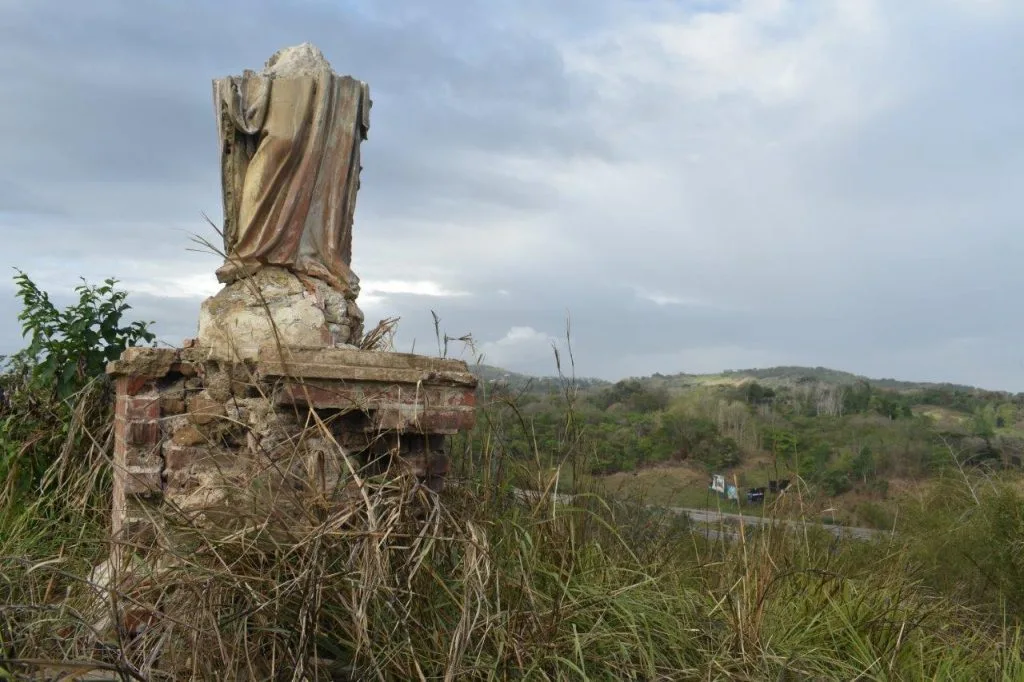
The Claxton Bay Maiden Photo Credit: Hayden Roach, Life in Trinidad and Tobago
We encourage every citizen to play their part in safeguarding our cherished heritage assets, and to treat them with respect and dignity. We encourage you to reach out to us, the National Trust of Trinidad and Tobago, to not just learn about and heritage but to experience it. We believe that through education and understanding, we can foster appreciation and encourage every individual to take responsibility for our heritage. Anyone can nominate a heritage asset to the inventory by clicking the following link. You can email the Trust at info@nationaltrust.tt and heritage@nationaltrust.tt for more information.
Sources
Bissessarsingh, Angelo. 2016. “The milk sellers of Port-of-Spain”. Trinidad and Tobago Guardian. https://www.guardian.co.tt/article-6.2.354296.8a57493351
“Lady on the Hill haunts ‘death strip’ Angry ghost blamed for road carnage.” Daily Express, May 24, 2009. https://trinidadexpress.com/news/local/lady-on-the-hill-haunts-death-strip/article_d1b41be4-db13-53e5-b61d-bb7944b3d1e9.html
Maclean, Geoffrey. Facebook. 2020.
https://www.facebook.com/photo.php?fbid=10158192512826187&set=p.10158192512826187&type=3
“Maria And the Statue on the Hill”, LIFEINTRINIDAD Marketing Limited. September 17, 2021. https://lifeintrinidadandtobago.com/articles/education/maria-and-the-statue-on-the-hill/
Maria and The Statue on the Hill. Life In Trinidad and Tobago. September, 2021.
https://lifeintrinidadandtobago.com/articles/education/maria-and-the-statue-on-the-hill/
“The Haunting of the Solomon Hochoy Highway,” Highways of Trinidad. Javed Jaggassar, 2016. https://highwaysoftrinidad.wordpress.com/highway-folklore/the-haunting-of-the-solomon-hochoy-highway/